
You want to bring someone on at RM 5,000 a month. Simple enough. But by the time you account for EPF, SOCSO, and EIS, the real monthly cost of that hire is closer to RM 5,900, before they’ve delivered a single output.
For a fast-growing company watching every ringgit, that gap matters. And it grows significantly wider when you add a placement fee, onboarding time, and what happens if the hire doesn’t work out.
This guide breaks down the real difference between contract staffing and permanent placement in Malaysia, what each model costs, when each makes sense, and how to decide without second-guessing yourself six months later.
Contract staffing means bringing on a worker for a defined period or project, typically 3 to 24 months without the long-term obligations of a permanent employment relationship.
The worker is placed by a staffing firm, which acts as the employer on your behalf: handling payroll processing, EPF, SOCSO, and EIS compliance. You pay a consolidated monthly rate and stay focused on managing the work, not the paperwork.
Permanent placement is the traditional hiring model: you recruit someone into a full-time, open-ended role within your organisation. They are on your payroll, entitled to all statutory benefits, and if things go well, they become part of your team’s institutional knowledge base.
A permanent hire is an investment. They take longer to onboard, cost more upfront, and carry ongoing obligations. But they also build deep company knowledge, develop genuine loyalty, and take on responsibilities that a short-term contractor typically will not.
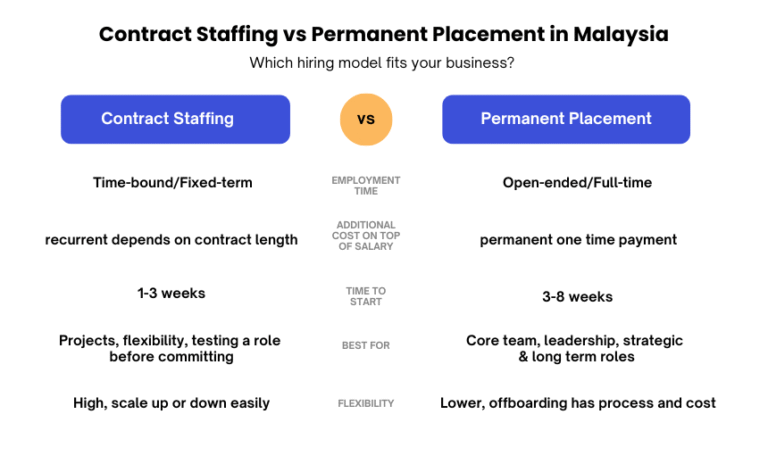
Contract staffing is the right call when:
Your growth trajectory is still uncertain. If you’re scaling fast but aren’t yet sure which functions will be permanent fixtures, contract staffing lets you move quickly without over-committing. You can validate whether a role is genuinely needed before locking in a salary and all the obligations that come with it.
The work is project-based or time-bound. A product launch, a system migration, a market expansion. These have natural start and end points. A permanent hire for a time-limited need creates a headcount problem the moment the project wraps.
Cost predictability is important. The consolidated rate for a contract worker is fixed and transparent. No EPF contributions to track separately, no annual leave accrual building up, no severance complexity. For startups managing runway, this is a genuine advantage over the variable and growing cost of permanent employment.
You want to evaluate before committing. Many companies use contract placements as an extended trial: the contractor delivers in the role, both sides build trust, and a permanent offer follows if the fit is right. It significantly reduces the risk and cost of a bad hire.
You need a specialist skill for a defined window. A specific tech stack, a niche compliance function, a language capability, these don’t always justify a permanent hire with all its ongoing overhead. Contract staffing fills the gap cleanly.
Permanent placement is the right call when:
The role is strategic or leadership-level. Your Head of Finance, Country Manager, or Head of People. These roles require deep context, long-term ownership, and the kind of commitment you can only get from someone who is fully invested. Contractors don’t build culture.
You need institutional continuity. Some roles accumulate value over time: client relationships, system ownership, regulatory expertise. That accumulated knowledge is a business asset. Losing it when a contract ends is expensive in ways that don’t show up in the monthly invoice.
You are building your core team. The first 15 to 20 permanent hires at a growing company set the culture and the capability ceiling for everything that follows. Getting these people right and keeping them is worth the cost of a proper search and a considered offer.
The contract vs. permanent question doesn’t have to be binary. Most companies at scale run a deliberate mix and managing that mix well is a genuine competitive advantage.
A practical split many fast-growth businesses in Malaysia use:
Use Contract Staffing For
Use Permanent Placement For
At Great Pyramid, we run both models under one roof. Our permanent placement practice covers executive search and direct hire across Finance, IT, HR, and Oil & Gas. Our contract staffing practice delivers flexible headcount with full payroll and statutory compliance managed on your behalf, so you get the team you need without the administrative weight.
The challenge is managing two separate vendor relationships, two billing structures, and two sets of compliance requirements. A single HR partner who handles both removes that overhead and keeps your hiring strategy aligned with your actual growth stage.
Yes and it happens frequently. Many companies use contract staffing as an extended evaluation period: the contractor performs the role, both sides build trust, and a permanent offer follows if the fit is right. Great Pyramid facilitates this conversion process regularly. There is no legal barrier to converting a contract placement to permanent employment at any point, provided both parties agree.
When you hire through a contract staffing firm like Great Pyramid, the staffing firm acts as the employer of record and handles all statutory contributions EPF, SOCSO, and EIS on your behalf. You pay a single consolidated monthly rate; the compliance is the firm’s responsibility. This is one of the core reasons companies use contract staffing: it removes the administrative and regulatory burden from your team entirely.
Yes. Fixed-term contract employment is recognised and governed under the Employment Act 1955 and related Malaysian labour regulations. It is widely used across industries including manufacturing, IT, professional services, and oil and gas. Contracts must be properly documented and compliant with statutory requirements, your staffing partner is responsible for ensuring this when they act as employer of record.
This depends on the contract terms agreed upfront. Most contracts include an early termination clause specifying a notice period (typically 1–2 months) or a buyout provision. It is important to negotiate clear exit terms before the placement begins rather than after. Great Pyramid includes explicit early termination provisions in all contract placements so both parties know their obligations from day one.
A freelancer (independent contractor) is self-employed,they invoice directly, manage their own taxes, and have no formal employment protections under Malaysian law. A contract staff member placed through a staffing firm is a salaried employee of that firm: fully statutory-compliant, covered by EPF, SOCSO, and EIS, and entitled to employment protections. For most business needs, contract staffing through a firm is significantly safer and more reliable than ad-hoc freelance arrangements particularly for roles lasting more than a few weeks.